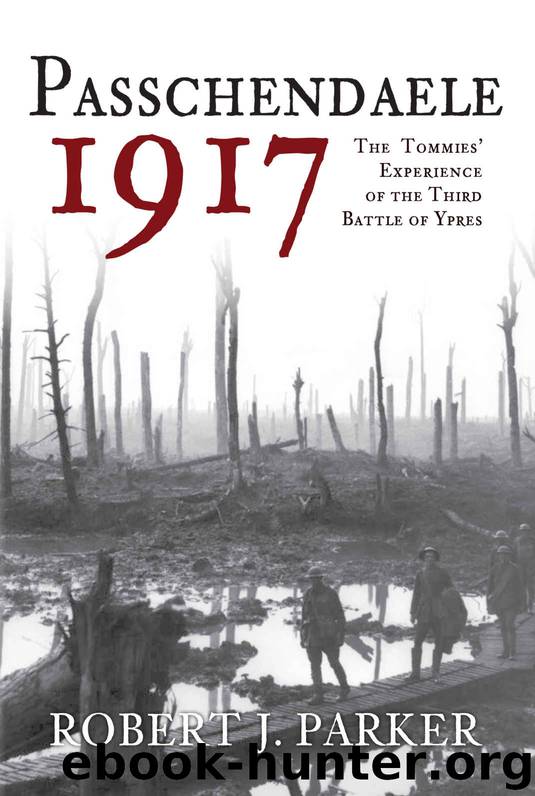
Passchendaele 1917: The Tommies' Experience of the Third Battle of Ypres by Robert J Parker
Author:Robert J Parker [Parker, Robert J]
Language: eng
Format: azw3
Publisher: Amberley Publishing
Published: 2017-06-19T04:00:00+00:00
In concert with the early August renewal of the effort to finally capture Gheluvelt Ridge, the British decided on a simultaneous diversionary attack further south near the French town of Lens. The operation would not only attempt to take Lens, an important German rail junction, but also divert German forces from relieving the Ypres front. Therefore, roughly two weeks after the renewed attempts on the Gheluvelt Ridge, the Battle for Hill 70 commenced outside Lens. Hopefully, this show of force to the south would relieve pressure at Ypres by preventing the Germans from being able to transfer fresh troops from the Lens sector to the relief of the Ypres Salient. For this task, General Haig chose the Canadian Corps under Lieutenant General Sir Arthur Currie, who had risen to prominence along with his immediate superior and now British Third Army commander, Lieutenant General Sir Julian Byng. Together they had conceived and conducted the successful spring 1917 attack at Vimy Ridge, a strategically important and redoubtable German position in north-western France, which had previously resisted all attempts to capture it.
While this secondary operation for the capture of Hill 70 was taking place, the main British Army on the Ypres Salient began preparing for the next big push – a flanking attack centred on the village of Langemarck, north of the Gheluvelt Ridge. The capture of Hill 70 and the preparation for the upcoming push at Langemarck went on concurrently, while fighting within the Salient remained constant, with heavy casualties continuing. The Battle for Hill 70, although outside the Flanders theatre, was to affect the Third Battle of Ypres in two ways. It was to provide diversionary cover for the upcoming British push at Langemarck as intended; and its success would later lead to General Currie and the Canadian Corps being chosen by Haig for the final drive that would capture Passchendaele and complete the offensive.
Located outside the French coal-mining town of Lens, Hill 70 dominated the nearby area, including the German-controlled railhead centre of Lens. As at Vimy Ridge, the Canadians, under General Currie, would rely on meticulous planning and rehearsal, heavy artillery in a narrow range of frontal attack, and the invitation to local commanders to go forward, where possible, on their own initiative. ‘Bite and hold’ would be the goal, rather than deep penetrations. Each soldier would carry a map of his designated area, and have a firm grasp of the design and geography of it. Each soldier would be prepared to take over his platoon or accompanying assault group in case his fellow non-commissioned officers should fall or be wounded.
Currie, and the entire Canadian force for that matter, believed in the economical use of manpower. Trained in artillery, Currie believed in the ‘shells not soldiers’ school of a massed concentration of artillery to do the preliminary work on the battlefield prior to an assault. Currie’s was a progressive doctrine in approach and preparation. He encouraged his fellow officers to offer competing points of view and was readily willing to alter his plans if better ones were presented.
Download
This site does not store any files on its server. We only index and link to content provided by other sites. Please contact the content providers to delete copyright contents if any and email us, we'll remove relevant links or contents immediately.
| Africa | Americas |
| Arctic & Antarctica | Asia |
| Australia & Oceania | Europe |
| Middle East | Russia |
| United States | World |
| Ancient Civilizations | Military |
| Historical Study & Educational Resources |
The Radium Girls by Kate Moore(12112)
100 Deadly Skills by Clint Emerson(4983)
Rise and Kill First by Ronen Bergman(4857)
The Templars by Dan Jones(4751)
The Doomsday Machine by Daniel Ellsberg(4576)
The Rape of Nanking by Iris Chang(4276)
Killing England by Bill O'Reilly(4065)
Stalin by Stephen Kotkin(4024)
Hitler in Los Angeles by Steven J. Ross(3993)
12 Strong by Doug Stanton(3590)
Hitler's Monsters by Eric Kurlander(3411)
The Code Book by Simon Singh(3269)
Blood and Sand by Alex Von Tunzelmann(3256)
Darkest Hour by Anthony McCarten(3184)
The Art of War Visualized by Jessica Hagy(3058)
Hitler's Flying Saucers: A Guide to German Flying Discs of the Second World War by Stevens Henry(2785)
Babylon's Ark by Lawrence Anthony(2744)
Tobruk by Peter Fitzsimons(2575)
The Second World Wars by Victor Davis Hanson(2559)
